


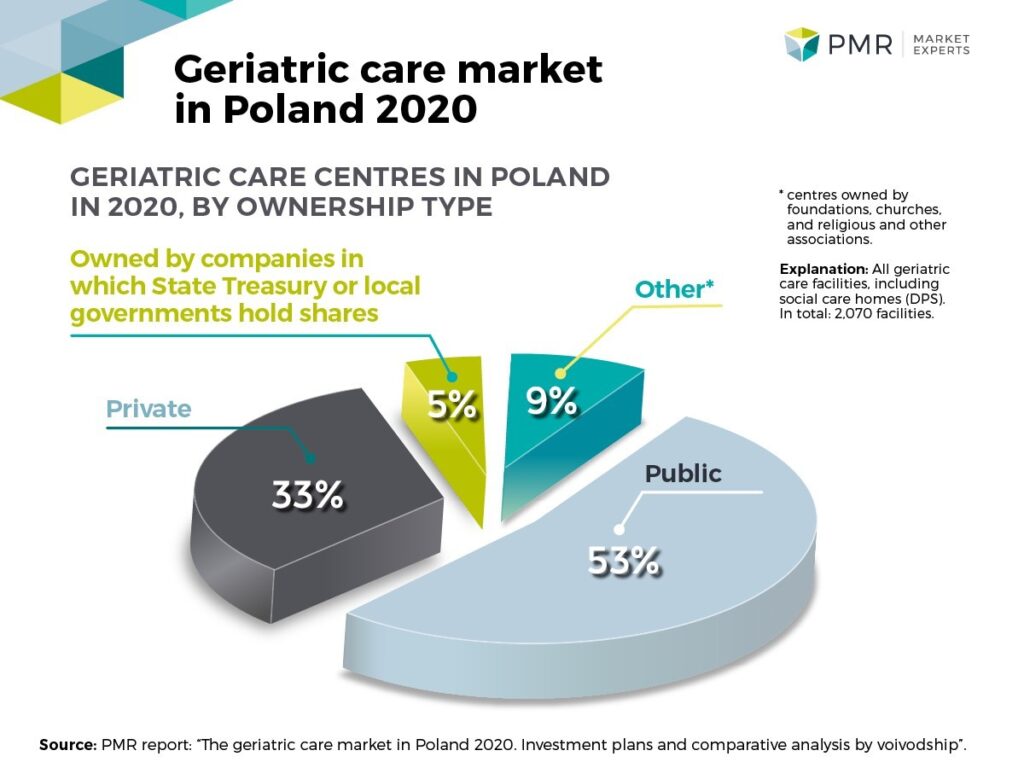
Care for the elderly in Poland remains concentrated in social care homes (DPS), which are part of the public system. But demand for private nursing homes has been growing – and so has supply, according to a new report from PMR, “The geriatric care market in Poland 2020. Investment plans and comparative analysis by voivodship”.
Market dominated by public facilities
DPS account for 43% of all residential long-term care facilities for seniors in Poland, and contain over 60% of all beds. They are mostly large establishments, and size in this case does not always go hand in hand with quality of service. This, as well as a shortage of places relative to need, is stimulating demand for commercial services. As our analysis shows, the number of facilities where residents pay out of pocket (rather than through the NFZ or pension) has been growing dynamically in recent years. These private or commercial institutions offer smaller rooms and numerous amenities and services, e.g. relaxation zones, beauty zones, marital apartments, etc.
So-called 24-hour care facility is the format responsible for most of the growth in private institutions in recent years. A majority of the almost 700 private centres are 24-hour care facilities. It is worth noting, however, that a large part of the people staying in DPS will never become clients of private institutions, due to limited financial means at their disposal.
The northeast has the smallest centres
Our analysis of commercial care homes for seniors shows that the voivodships with the smallest centres – 36-37 beds on average – are Pomorskie, Warminsko-Mazurskie, and Podlaskie. As it happens, these are also the provinces where, according to our forecasts, the population will grow at the fastest rate in the years until 2030. They may face a significant problem with care for the elderly in the future.
Lubuskie is the region with the highest number of beds per centre, at 61. In this province there are relatively few 24-hour care centers (32% of all centers, compared to a national average of 47%), which are characterized by a small number of beds.
AUTOR
Monika Stefańczyk
Pharma and Healthcare Business Unit Director
KONTAKT DLA MEDIÓW
monika.stefanczyk@corporate.com`
Recent posts

PMR’s report: Poles cut down on expenses but fashion does not come first
PMR’s estimates indicate that in 2022 the market will record growth again, mainly on the back of increased demand for…

PMR: PLN 58bn online sales of services in 2022
Data from the latest PMR report “Online retail of services in Poland 2022. E-commerce market analysis and development forecasts for…

PMR: Record-breaking cosmetics market growth in 2022
PMR forecasts that in 2022 the cosmetics market in Poland will grow by 6.1% YoY, to around PLN 27.7bn. This…

PMR Hospital Outcomes Index highest for private hospitals
The situation on the hospital market over the last 10 years was at its worst in autumn 2020, according to…

PMR: Ready-to-eat meals market in Poland is stable in difficult times
The ready-to-eat meals market in Poland is growing rapidly, being in a relatively early phase of development. In 2021, this…

PMR: Value of pharmaceutical distribution in Poland reached PLN 56bn in 2021
According to the latest PMR report “Distribution on the pharmaceutical market in Poland 2022. Market analysis and development forecasts for…